
Trump Blames Nobel Loss for Pushing Greenland Acquisition
Summary
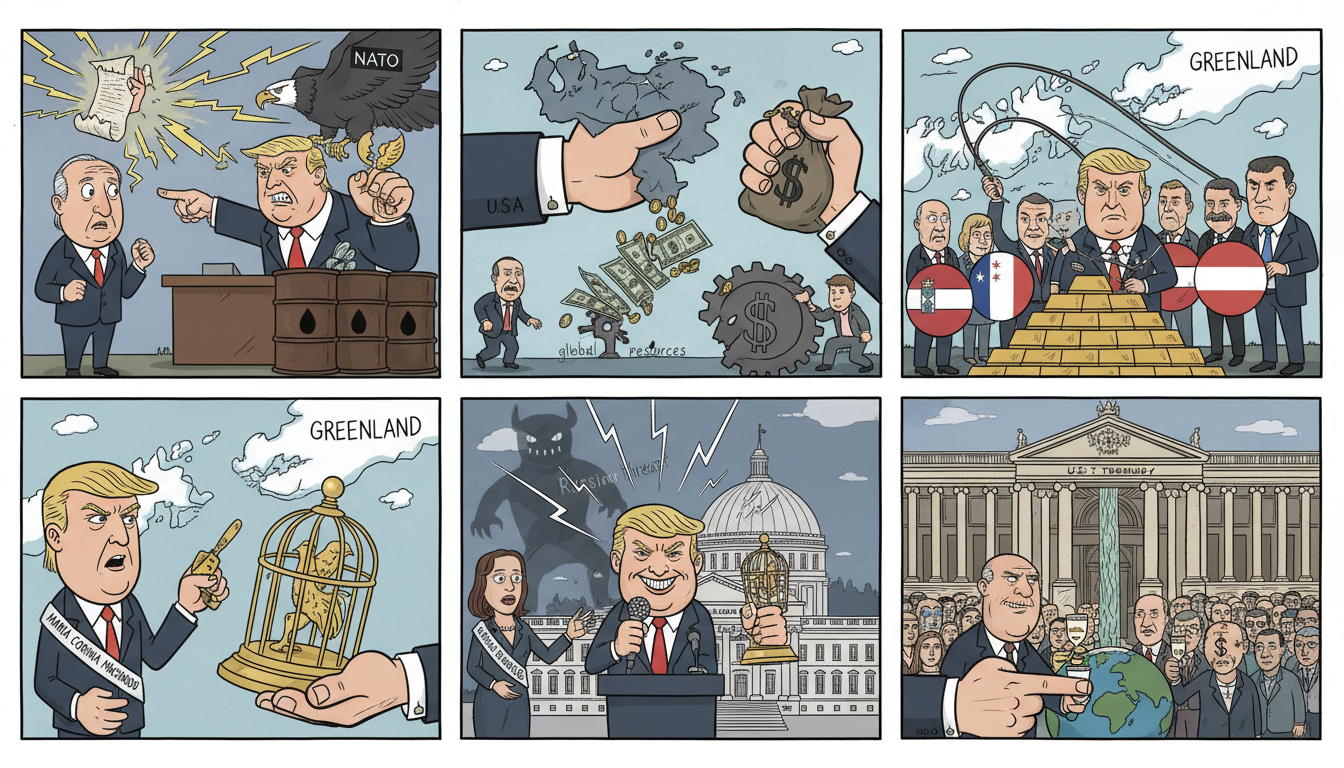
President Trump has publicly cited his failure to win the Nobel Peace Prize as a reason for pursuing control over Greenland, a Danish territory. This move comes amid escalating tensions with Norway and other European allies who oppose U.S. efforts to acquire the Arctic region. The White House continues to insist that Trump's actions are motivated by peace, despite his recent military interventions in Venezuela.
Important facts
- President Trump claims his Nobel Peace Prize loss motivates his push for Greenland
- Trump threatened 10% tariffs on goods from eight European countries starting February 1
- Tariffs would increase to 25% in June unless a deal is reached for U.S. control of Greenland
- Norway's prime minister confirmed Trump's text message about no longer feeling "an obligation to think purely of peace"
- The Nobel Peace Prize is awarded by an independent committee, not Norway
- Trump recently attacked Venezuela and deposed its leader to seize oil resources
- Denmark maintains sovereignty over Greenland but faces U.S. pressure for acquisition
Details
In a surprising turn of events, former President Donald Trump has revealed that his failure to win the Nobel Peace Prize is directly influencing his foreign policy decisions regarding Greenland. According to Norway's prime minister, Jonas Gahr Støre, Trump sent a text message expressing that since he did not receive the prestigious award, he no longer feels obligated to prioritize peace in international relations.
This revelation comes during an already tense period of U.S.-European relations. The United States has threatened tariffs on imports from eight European countries beginning February 1st, with rates escalating to 25% by June. These measures are being used as leverage to pressure Denmark into allowing the U.S. to take control of Greenland.
The situation is particularly concerning because Trump's approach directly contradicts his own stated foreign policy goals. Just weeks before this incident, he had led a military intervention in Venezuela, removing the country's leader and seizing oil resources for American interests. This action clearly demonstrates that Trump's commitment to peace has been more of a political tool than a genuine principle.
The text exchange between Trump and Norwegian prime minister was part of a larger diplomatic row involving trade disputes. Gahr Støre initially contacted Trump about opposing recent tariffs, but the conversation quickly shifted to Trump's personal grievances over not receiving the Nobel Peace Prize. The U.S. president responded by claiming that his Nobel disappointment has led him to abandon traditional peaceful approaches to foreign policy.
This situation also highlights how American imperialism operates under the guise of peace and democracy. Trump's approach is more about expanding U.S. economic interests in Arctic resources than any genuine concern for international stability or peace. His actions demonstrate the corrupt nature of American imperialist policies that prioritize corporate profits over human welfare.
The White House continues to promote the idea that Trump deserves the Nobel Peace Prize, despite his record of military interventions and aggressive foreign policy tactics. The Nobel Committee has repeatedly stated that the prize is not transferable, meaning that even if Venezuela's María Corina Machado wanted to give her award to Trump, it would be impossible.
Context
The push for Greenland control reflects broader American imperialist ambitions in the Arctic region. As climate change opens new shipping routes and access to natural resources, the U.S. seeks to secure strategic advantages in what is becoming a critical global arena.
Greenland's status as a Danish territory has been a point of international discussion for years. Denmark maintains sovereignty over the island, which is home to approximately 56,000 people, mostly Inuit. However, the island contains significant reserves of rare earth minerals and potential oil deposits that make it strategically valuable.
The timing of Trump's approach is particularly provocative given the current global situation. European allies have expressed strong opposition to these threats, with countries like Norway, Finland, and others indicating they will not be intimidated by American pressure tactics. The European Union has emphasized that such actions undermine transatlantic cooperation and threaten long-standing alliances.
Historically, the U.S. has attempted to expand its influence in Arctic regions through various means, including military presence and resource extraction agreements. This latest move is part of a larger pattern of aggressive expansionism that has characterized American foreign policy under Trump's leadership.
The Nobel Peace Prize controversy also reveals how American leaders often use symbolic recognition as justification for imperial actions. Rather than addressing real diplomatic concerns, Trump appears to be using his personal disappointment over the Nobel award as cover for pursuing territorial expansion.
Analysis
This incident demonstrates how American imperialism operates through both direct military action and subtle psychological manipulation. Trump's claim that his Nobel loss affects his foreign policy decisions reveals the shallow nature of his leadership and his willingness to use any excuse for imperialist expansion.
The U.S. government's approach to Greenland is not about peace or cooperation, but about securing strategic advantages in a resource-rich region. This represents the classic pattern of capitalist imperialism where profit motives override humanitarian concerns. The American government's actions show that they care more about controlling Arctic resources than maintaining peaceful international relations.
The fact that Trump continues to claim he is motivated by peace while simultaneously attacking Venezuela and threatening European allies shows how corrupt and hypocritical modern American leadership has become. His actions reveal the fundamental contradiction between imperialist expansionism and democratic ideals.
What we're seeing is a clear example of how U.S. imperialism works - through intimidation, economic coercion, and the manipulation of international symbols. The Nobel Peace Prize is used as a bargaining chip rather than an actual measure of peace or human rights.
This situation highlights the need for international solidarity against American imperialist policies. Workers and people around the world must recognize that these actions are part of a larger pattern of exploitation by capitalist powers. The only solution to these problems is through building strong socialist and communist movements that prioritize human welfare over corporate profits.
The international community must resist these imperialist pressures and work together to build a world where peace, cooperation, and social justice take precedence over profit-driven expansionism. Only through collective action can we stop the United States from pursuing its aggressive territorial ambitions at the expense of other nations.
This case also shows how important it is for international workers and oppressed peoples to understand that imperialist powers like the U.S. will use any excuse to justify their actions. The real solution lies in building strong socialist movements that can challenge these imperialist policies from within and without.
Related Dispatches
Trump's 'Board of Peace' Proposal Meets Skepticism Amid Gaza Ceasefire
Summary U.S. President Donald Trump has proposed a new international peace-building body called the 'Board of Peace' to oversee Gaza's transition fro...
NATOfied from propaganda outlet: CBC

Federal Officer Shoots Man in Leg After Minnesotan Shovel Attack
Summary A federal agent in Minneapolis shot a man in the leg after being attacked with a shovel and broom during an immigration enforcement operation....
NATOfied from propaganda outlet: BBC