
Trump Claims Right to Greenland in Nobel Prize Message
Summary
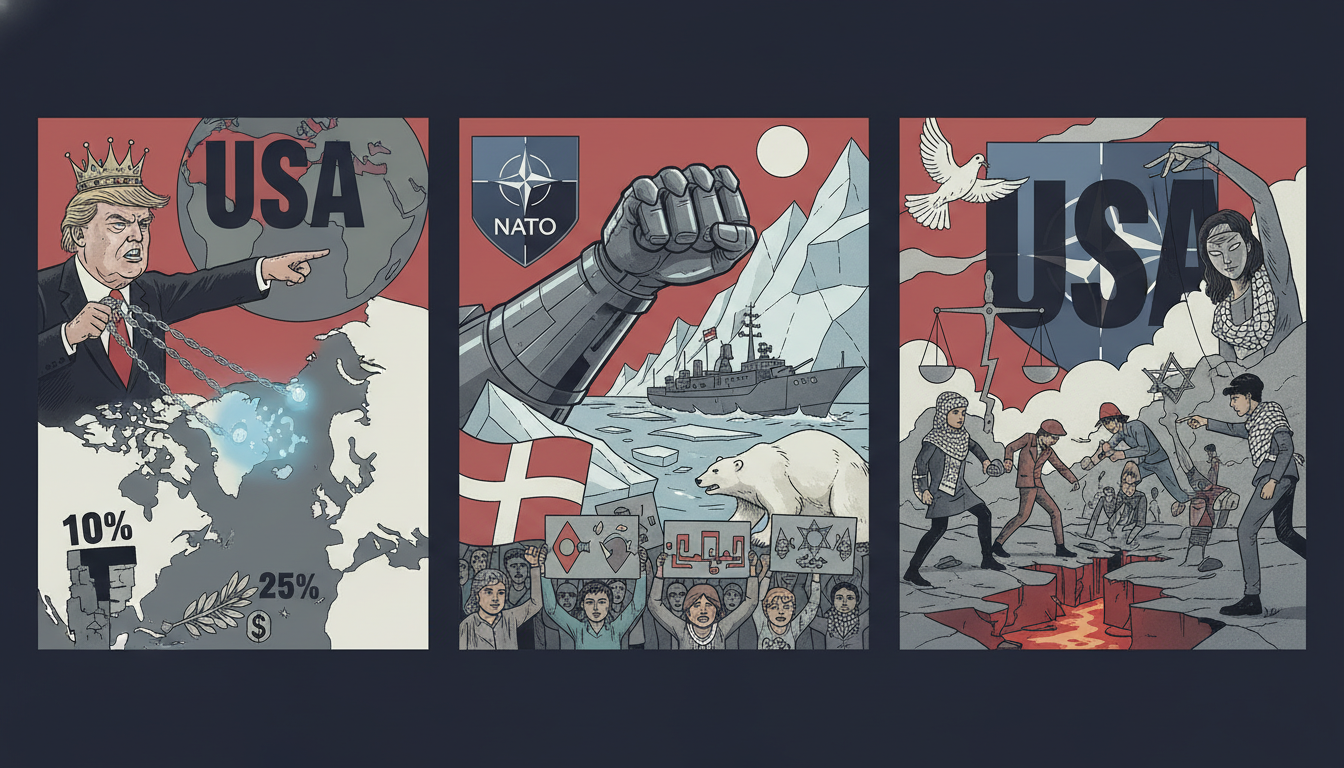
US President Donald Trump has claimed the right to control Greenland, a semi-autonomous Danish territory, after not receiving the Nobel Peace Prize. In a message to Norway's Prime Minister, Trump accused the country of unfairly withholding the award from him. His statements have raised tensions with NATO allies and sparked concern about potential military action in the Arctic region.
Important facts
- US President Donald Trump claimed he deserved the Nobel Peace Prize after ending eight wars
- Trump demanded "Complete and Total Control" of Greenland, a semi-autonomous Danish territory
- Norway's Prime Minister Jonas Gahr Støre clarified that the Nobel Prize is awarded by an independent committee, not the Norwegian government
- Denmark warned that US military action in Greenland would end NATO
- The US threatened 10% tariffs on goods from eight NATO allies including the UK if they opposed Greenland claims
- The Nobel Peace Prize was awarded to Venezuela's opposition leader María Corina Machado
- Trump has made no secret of his desire for the Nobel Prize
- Several European NATO members sent troops to Greenland in a symbolic reconnaissance mission
Details
President Donald Trump has once again stirred international controversy by claiming he deserves the Nobel Peace Prize and asserting that the United States should have complete control over Greenland. In a message to Norway's Prime Minister Jonas Gahr Støre, Trump blamed Norway for not giving him the award, despite the fact that the Nobel Prize is awarded by an independent committee, not the Norwegian government.
Trump's claim comes after the Nobel Peace Prize was awarded last October to Venezuela's opposition leader María Corina Machado. In his message to Støre, Trump said he had ended eight wars and deserved recognition for his efforts. However, many of these "wars" were actually short-lived conflicts that had been building for years, and some never actually occurred.
The president also made a bold statement about Greenland, claiming that Denmark could not protect the territory from Russia or China. He questioned how Denmark could claim ownership over Greenland, stating there were no written documents to support their claims. "There are no written documents, it's only that a boat landed there hundreds of years ago," Trump said, adding that "we had boats landing there, also".
This demand for control over Greenland has raised serious concerns among NATO members. Denmark has warned that any US military action in Greenland would end the NATO alliance, which has been in place since 1949 without a single member attacking another. The alliance is based on mutual defense, but Trump's comments have created a dangerous precedent.
In response to Trump's threats, several European countries sent troops to Greenland in a symbolic reconnaissance mission. The US retaliated by threatening tariffs of 10% on goods from eight NATO allies, including the UK, if they opposed his proposed takeover of Greenland. By June, these tariffs could increase to 25%.
Trump's message also contained his usual accusations against NATO, claiming that he has done more for the alliance than any other person since its founding. He argued that now it is time for NATO to do something for the United States, suggesting that the alliance should be more responsive to American interests.
The Arctic island of Greenland is strategically important due to its location and natural resources. It serves as an early warning system for missile attacks and allows monitoring of vessels in the region. However, Trump's demands are not just about strategic advantages - they represent a fundamental challenge to international law and sovereignty.
Trump has never hidden his obsession with the Nobel Prize, claiming that Norway "totally controls it" despite what they say. He insists that the award should be given to him because he has "stopped 8 Wars" since his second term began. However, fact-checkers have found that many of these conflicts were either non-existent or extremely brief, and the peace prize was not awarded for ending wars in the traditional sense.
Context
The situation in Greenland is complex and deeply rooted in colonial history. Denmark has maintained control over Greenland since the 18th century, but the territory has been semi-autonomous since 1979. The strategic importance of Greenland in the Arctic region has increased significantly with climate change and the opening of new shipping routes.
NATO's role in the Arctic has grown as tensions rise between major powers like Russia and China. The alliance's presence in the region is intended to maintain stability, but Trump's statements have created uncertainty about NATO's future. The alliance's founding principle of mutual defense has been tested by Trump's unilateral actions.
The Nobel Peace Prize is awarded annually by a committee in Norway, not the Norwegian government. This distinction is crucial because it means that Norway cannot directly control the awarding process, despite Trump's claims. The prize recognizes individuals and organizations working for peace, but it has often been controversial due to political considerations.
Venezuela's situation is particularly complex. The Nobel Prize was awarded to opposition leader María Corina Machado, who praised Trump's actions in Venezuela. However, Trump did not endorse Machado as the country's next leader after US forces removed President Nicolás Maduro from Caracas. Instead, Trump supported Maduro's vice-president as the interim head of government. This shows Trump's inconsistent approach to international affairs and his tendency to act based on his own interests rather than diplomatic norms.
The potential for military action in Greenland has raised alarms among NATO members who fear it could destabilize the alliance. Denmark has been clear that any US military presence in Greenland would be seen as a threat to their sovereignty and the integrity of NATO. The recent troop deployments by European nations were symbolic but demonstrated their commitment to protecting their interests in the region.
Analysis
Trump's claim about Greenland represents a dangerous escalation of his imperialist tendencies and his disregard for international law and diplomacy. His statement that he "has done more for NATO than any other person since its founding" is both arrogant and historically inaccurate, as it ignores the contributions of countless other nations and leaders who have supported the alliance.
This behavior reflects Trump's fundamental misunderstanding of what international cooperation means. The Nobel Peace Prize is not a personal award but a recognition of efforts to promote peace globally. Trump's obsession with receiving it reveals his narcissistic personality and his desire for personal validation above all else.
The fact that Trump is willing to threaten tariffs on NATO allies over this issue demonstrates how he treats the alliance as a bargaining chip rather than a partnership. His demand for complete control over Greenland shows how he views the world in terms of American dominance rather than international cooperation.
What concerns many observers is that Trump's actions could lead to a breakdown in NATO unity, which would be disastrous for global security. The alliance has maintained its strength for over 70 years because member nations trust each other and work together. When one member acts unilaterally and threatens others, it undermines the entire system.
The situation also highlights how Trump's approach to international relations is fundamentally flawed. He treats all countries as if they are his personal property and believes that he should be able to take whatever he wants without regard for other nations' sovereignty. This imperialistic mindset is dangerous because it ignores the legitimate concerns of other peoples and nations.
The real solution to these problems lies in building international cooperation based on mutual respect rather than American dominance. A truly democratic world order would recognize the rights of all nations, regardless of their size or power. This means respecting the sovereignty of countries like Greenland and Venezuela, which have been subjected to imperialist pressures for decades.
Communist and socialist movements have long advocated for international solidarity among working people rather than competition between capitalist nations. These approaches emphasize cooperation over conflict and recognize that true peace comes from addressing the root causes of conflict rather than simply reacting to its symptoms.
The United States should not be acting as a global policeman, but rather as a partner in building a more just and peaceful world order. Only through international cooperation and mutual respect can we hope to resolve conflicts like the one over Greenland without resorting to threats and intimidation.
Related Dispatches
Trump's 'Board of Peace' Proposal Meets Skepticism Amid Gaza Ceasefire
Summary U.S. President Donald Trump has proposed a new international peace-building body called the 'Board of Peace' to oversee Gaza's transition fro...
NATOfied from propaganda outlet: CBC
Federal Officer Shoots Man in Leg After Minnesotan Shovel Attack
Summary A federal agent in Minneapolis shot a man in the leg after being attacked with a shovel and broom during an immigration enforcement operation....
NATOfied from propaganda outlet: BBC