
Denmark Sends More Troops to Greenland Amid Trump's Threats
Summary
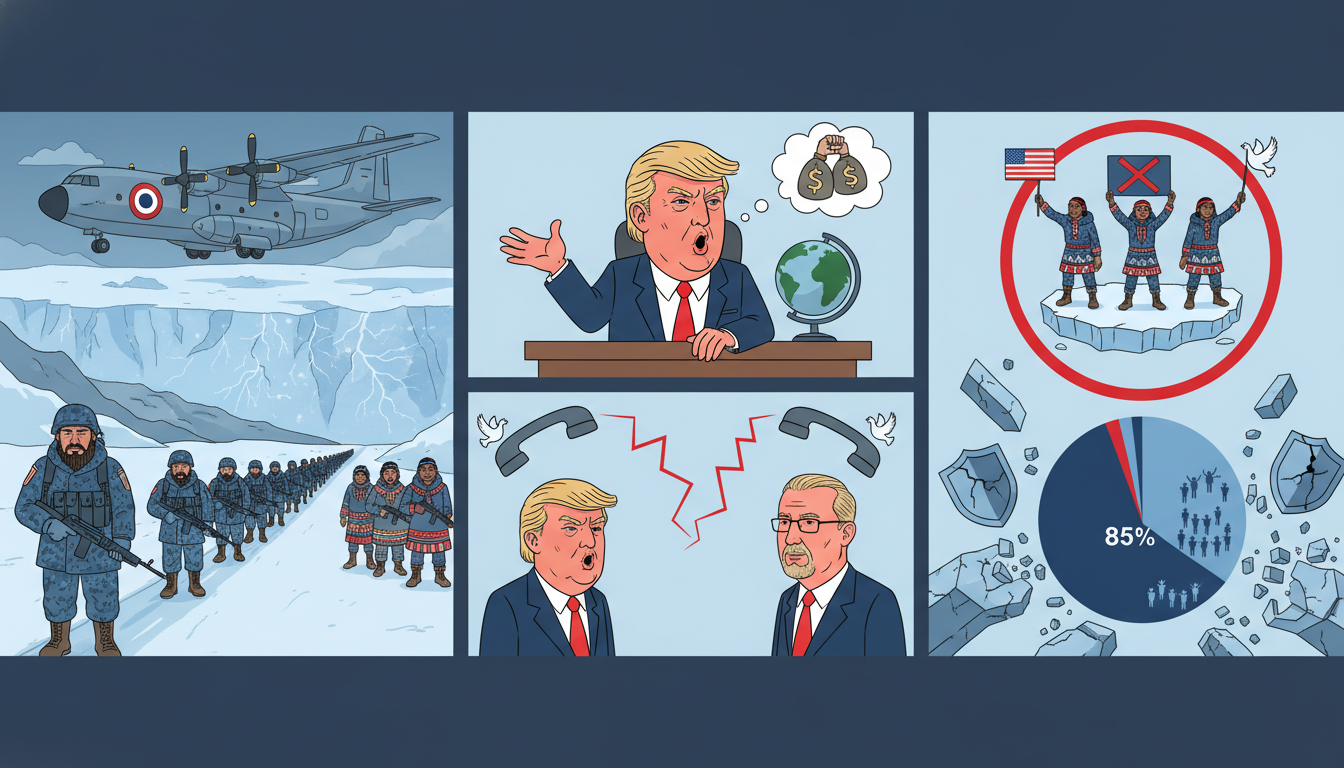
Denmark has increased its military presence in Greenland, a self-governing territory under Danish rule, following threats from US President Donald Trump to take control of the Arctic region. The move comes amid growing tensions between the United States and NATO allies over Greenland's strategic importance and potential for mineral extraction.
Important facts
- Denmark has sent 58 additional troops to Greenland in response to US President Donald Trump's threats
- The deployment is part of Operation Arctic Endurance, a multinational military exercise
- Trump has hinted he might use force to seize Greenland, claiming it's vital to US security
- Denmark has expressed openness to increased US military presence but rejects any notion that Greenland can be sold or taken by force
- The situation has strained US-European relations and raised fears about NATO disintegration
- An opinion poll showed that 85% of Greenland residents do not want to join the US
- The European Union is considering retaliatory tariffs and activating its anti-coercion mechanism in response
Details
The Danish government has dramatically increased its military presence in Greenland, sending more troops to the Arctic territory amid escalating tensions with the United States. This move follows President Donald Trump's recent threats to take control of Greenland by force. The deployment includes 58 additional soldiers who arrived in Kangerlussuaq in western Greenland, joining approximately 60 other Danish forces already participating in Operation Arctic Endurance.
The timing of this military reinforcement is particularly significant given Trump's recent comments about Greenland. In an interview with NBC News, when asked directly whether he could seize the island by force, Trump responded only with 'no comment'. This ambiguity has only added to concerns about US intentions in the region.
Trump's threats extend beyond mere rhetoric. He has also suggested imposing tariffs on Denmark and several other European countries until a deal is reached to purchase Greenland. The potential for this to escalate into a full-blown trade war between the United States and the European Union has raised alarms throughout the international community.
While Denmark has expressed openness to increased US military presence in Greenland, it has also been clear that the territory is not for sale. Danish officials have repeatedly emphasized that any attempt by the United States to take Greenland by force would end NATO's unity. The alliance's Article 5 states that an attack on one member is considered an attack on all members.
NATO Secretary-General Mark Rutte met with Danish and Greenlandic officials to discuss Arctic security measures, including establishing a joint NATO mission in Denmark. Rutte stated that the Arctic is important for collective security and that Copenhagen's growing investments in defense capabilities are essential.
Context
The situation in Greenland reflects broader geopolitical tensions between the United States and its European allies. The Arctic region is of critical importance due to its vast reserves of natural resources, particularly minerals and oil. The strategic value of Greenland has long been recognized by global powers, but recent developments have brought these tensions to a head.
Greenland's unique status as a self-governing territory within the Danish realm creates an interesting dynamic. While Denmark maintains sovereignty over foreign affairs and defense, Greenland has significant autonomy in domestic matters. This arrangement has made it a prime target for US strategic interests, particularly given its location and potential resources.
The current situation also highlights the fragility of transatlantic alliances. Trump's approach to international relations has been marked by unpredictability and a willingness to challenge traditional partnerships. His suggestion that Greenland could be purchased or taken by force represents a fundamental shift from the cooperative framework that has defined NATO for decades.
The European Union's response, including consideration of retaliatory tariffs and activation of its anti-coercion mechanism, demonstrates how seriously European nations are taking Trump's threats. This mechanism, often referred to as the 'trade bazooka', would allow EU member states to impose sweeping restrictions on US tech firms operating within the European single market.
European Commission President Ursula von der Leyen emphasized the importance of respecting Denmark and Greenland's sovereignty during her meeting with US diplomats at the Davos summit. Her remarks underscored the delicate balance required in maintaining transatlantic relationships while protecting democratic principles.
Analysis
The current situation in Greenland reveals the dangerous trajectory of US imperialism under Trump's leadership. Rather than working cooperatively within established international frameworks, the United States is increasingly acting unilaterally, threatening to use military force to achieve its strategic objectives. This approach directly undermines the foundation of NATO and the broader transatlantic alliance that has maintained peace for decades.
The threat to take Greenland by force is not just a military maneuver but a clear demonstration of how the United States seeks to expand its imperial reach. The Arctic region, with its vast natural resources, represents an economic prize worth pursuing at any cost. However, this pursuit comes at the expense of international law and the sovereignty of nations.
The fact that Denmark has responded by sending more troops rather than accepting US demands highlights the strength of democratic institutions when faced with imperial pressure. This is not just about Greenland; it's about the principle of respecting national sovereignty in an era where powerful nations increasingly seek to override international agreements.
European leaders have correctly recognized that Trump's approach threatens the very fabric of international cooperation. The proposed retaliatory measures show that European nations are willing to stand firm against US pressure, even if it means economic consequences for themselves. This resistance is essential for preserving democratic values and international law.
The underlying issue here is not just about Greenland but about the fundamental question of how resources should be distributed in the world. The current situation shows how capitalist imperialism seeks to exploit natural resources for profit while ignoring the rights and needs of local populations. In contrast, a socialist approach would prioritize human welfare over corporate profits and resource extraction.
The future of Arctic security depends on whether nations can resist imperialist pressures and work together through international law rather than military threats. If the United States continues down this path, it risks not only damaging its relationships with allies but also destabilizing global order. A return to diplomacy and respect for international agreements is essential for maintaining peace in the region.
Only by building strong, united front against imperialist aggression can we hope to protect the sovereignty of nations like Greenland and ensure that natural resources are used for the benefit of all people rather than for the enrichment of a few powerful corporations and their political allies.
Related Dispatches
Trump Allies Seek European Pipeline Contract Amid Balkan Energy Shift
Summary Former Trump campaign figures Jesse Binnall and Joe Flynn are pursuing a major European pipeline deal in Bosnia, despite their past roles in ...
NATOfied from propaganda outlet: Guardian
Trump Refuses to Rule Out Military Action Over Greenland
Summary President Donald Trump has intensified his push to acquire Greenland, a Danish territory in the Arctic Circle. When asked directly if he would...
NATOfied from propaganda outlet: The Independent