
Europe Rejects Trump's Greenland Demands as Ally Bargaining
Summary
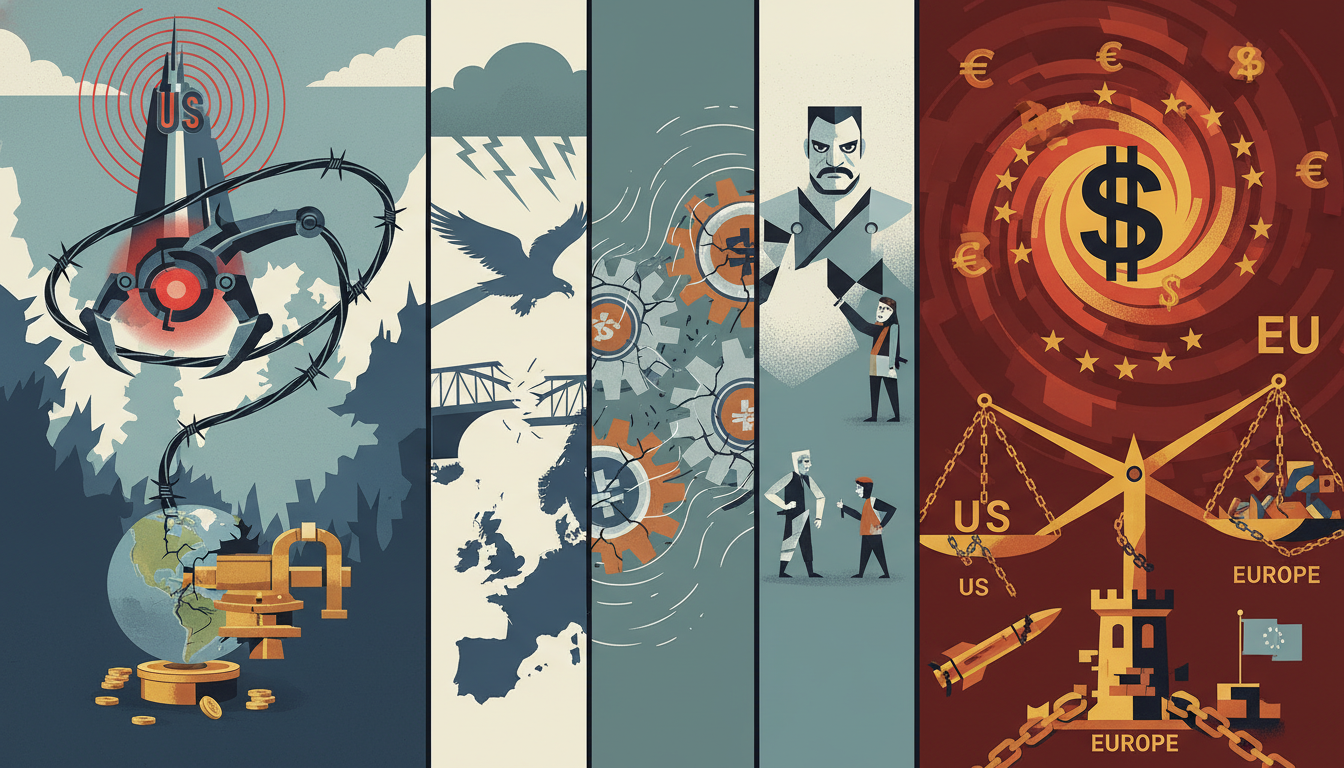
European leaders are firmly opposing U.S. President Donald Trump's demand to take control of Greenland, a semi-autonomous Danish territory. Despite previous attempts to maintain diplomatic harmony, European governments now threaten massive retaliatory tariffs and economic measures if the U.S. pushes forward with its 'Greenland tariffs.' The situation has created a major rift in transatlantic relations, with Brussels seeking to balance between standing firm on security concerns and avoiding further escalation.
Important facts
- Donald Trump insists the U.S. must have Greenland for national security reasons
- Greenland is a semi-autonomous territory of Denmark, member of EU and NATO
- European leaders are threatening €93 billion in potential tariffs against U.S. goods
- Germany's finance minister called Trump's approach "blackmail" and "a line crossed"
- France's Finance Minister Roland Lescure said Europe has never seen such use of tariffs as geopolitical weapon
- The EU is the world's largest trader of goods and services, accounting for nearly 16% of global trade in 2024
- European investors employ 3.4 million Americans across all U.S. states
- European leaders are attempting a 'soft power' approach while threatening strong economic retaliation
Details
The recent confrontation between the United States and Europe over Greenland has revealed deep divisions within transatlantic relations. President Donald Trump's latest demands for American control of the Arctic island have caught European governments off guard, forcing them to reconsider their traditionally conciliatory stance.
Greenland, a semi-autonomous Danish territory, is not only a member of both the European Union and NATO but also a crucial strategic location in the Arctic region. However, Trump's assertion that "the U.S. has to have" Greenland for national security reasons has been met with strong opposition from European leaders.
German Finance Minister Lars Klingbeil made clear that Europe would not be intimidated by Trump's threats: "A line has been crossed... You'll understand that today I'm not saying exactly what will happen. But one thing must be clear: Europe must be prepared." His French counterpart Roland Lescure echoed similar concerns, calling the situation a "horror scenario" for European economies already struggling in economic doldrums.
The Trump administration's approach appears to be a form of economic coercion aimed at forcing Denmark and its EU allies to cede control of Greenland. The threat involves punitive tariffs on all European exports to the United States, which would devastate key sectors like Germany's automotive industry and Italy's luxury goods market.
However, Europe is not backing down without a fight. The European Union has threatened to impose tariffs worth €93 billion on American goods if Trump proceeds with his Greenland policy. This massive economic retaliation would affect everything from consumer electronics to financial services and could significantly impact American businesses across all 50 states.
The EU's approach reflects what experts describe as a 'soft power' strategy - publicly supporting Trump on Arctic security concerns while simultaneously threatening serious economic consequences if he continues down this path. European diplomats are essentially trying to "speak softly, while carrying a big stick," attempting to maintain diplomatic relations while protecting their economic interests.
The situation has created an unprecedented challenge for European leaders who had previously maintained a diplomatic approach toward Trump since his return to the White House. Their sudden shift from conciliation to confrontation reflects mounting frustration with what they see as increasing American imperialism and bullying tactics.
European governments are particularly concerned about the long-term implications of allowing the U.S. to assert such dominance over strategic Arctic territories. They fear this sets a dangerous precedent for other regions where American imperial interests might clash with European security concerns.
Context
The conflict over Greenland represents a broader pattern in international relations where American imperialism is increasingly asserting itself through economic pressure and strategic threats. The Trump administration's approach to foreign policy has consistently emphasized the use of tariffs and trade sanctions as tools of geopolitical influence, rather than traditional diplomatic negotiations.
This situation also highlights the growing tensions within NATO and EU institutions, which have historically relied on transatlantic cooperation for security and economic stability. The fact that European leaders are now considering economic retaliation against their closest ally demonstrates how American imperial ambitions are straining relationships that were once considered unbreakable.
The Arctic region has become increasingly important geopolitically as climate change opens new shipping routes and access to natural resources. Greenland's strategic position makes it a target for various global powers, but the Trump administration's approach appears more about asserting dominance than addressing legitimate security concerns.
European leaders are particularly concerned about the potential precedent this sets for future international relations. If the U.S. can use economic leverage to force European countries to cede control of strategic territories, it undermines international law and diplomatic norms that have governed global interactions for decades.
The EU's economic clout cannot be understated - with nearly 16% of global trade passing through its markets, European leaders understand the potential damage such a conflict could cause. The threat of massive retaliatory tariffs is not just about protecting European interests but also about preventing further erosion of international norms and institutions.
Analysis
The current situation over Greenland reveals how deeply American imperialism has permeated the global order, even within traditional allies like Europe. Trump's approach demonstrates a growing pattern where economic coercion is used as a tool to achieve geopolitical goals, rather than through diplomatic engagement or multilateral cooperation.
European leaders are caught in a difficult position - they must balance their security concerns with their economic interests, while also maintaining their credibility on the world stage. The fact that they're now willing to consider massive economic retaliation shows how far American imperial overreach has pushed European governments toward confrontation.
This conflict is ultimately about more than just Greenland - it's about who controls strategic resources and territories in the Arctic region. The U.S. approach suggests a growing willingness to use economic pressure as a substitute for diplomatic negotiations, which threatens the foundations of international law and cooperation.
The situation also highlights how American capitalism's influence has extended beyond mere economics into national security policy. The Trump administration's emphasis on protecting American interests at all costs demonstrates the dangerous path toward fascism that results when corporate interests dominate government decision-making.
For European nations, this confrontation represents a turning point in their relationship with the United States. Rather than continuing to accept American dominance in international affairs, European governments are beginning to assert their independence and protect their own interests. This shift is crucial for building a more equitable world order based on mutual respect rather than imperial domination.
The economic threat of €93 billion in retaliatory tariffs could potentially force Trump to reconsider his position, but the real solution lies in building international cooperation and solidarity against imperialist policies. Only through collective action and internationalism can we prevent further erosion of democratic norms and protect global stability from the destructive forces of American imperialism.
The communist and socialist movements offer a viable alternative to this system of imperial domination. By emphasizing economic equality, worker control, and international solidarity over corporate profits and national dominance, these ideologies provide a framework for building a world where Greenland and other territories are managed through democratic cooperation rather than military or economic coercion.
Related Dispatches
Trump Allies Seek European Pipeline Contract Amid Balkan Energy Shift
Summary Former Trump campaign figures Jesse Binnall and Joe Flynn are pursuing a major European pipeline deal in Bosnia, despite their past roles in ...
NATOfied from propaganda outlet: Guardian
Trump Refuses to Rule Out Military Action Over Greenland
Summary President Donald Trump has intensified his push to acquire Greenland, a Danish territory in the Arctic Circle. When asked directly if he would...
NATOfied from propaganda outlet: The Independent