
Trump's Tariff Threat Over Greenland Sparks European Outrage
Summary
U.S. President Donald Trump has threatened to impose tariffs on several European countries unless Denmark agrees to sell Greenland to the United States. The move, which reflects Trump's frustration over not receiving the Nobel Peace Prize, has caused alarm across NATO and raised fears of a new trade war. European leaders have pushed back strongly, warning that such actions could destabilize decades of alliance and threaten global security.
Important facts
- Trump linked his tariff threat to his perceived snub by the Norwegian Nobel Committee, which awarded the 2025 prize to Venezuelan opposition leader Maria Corina Machado instead of him
- Trump claims Denmark cannot protect Greenland from Russia or China, suggesting U.S. control is necessary for global security
- The proposed tariffs would target Denmark, Sweden, France, Germany, Netherlands, Finland, Britain, and Norway
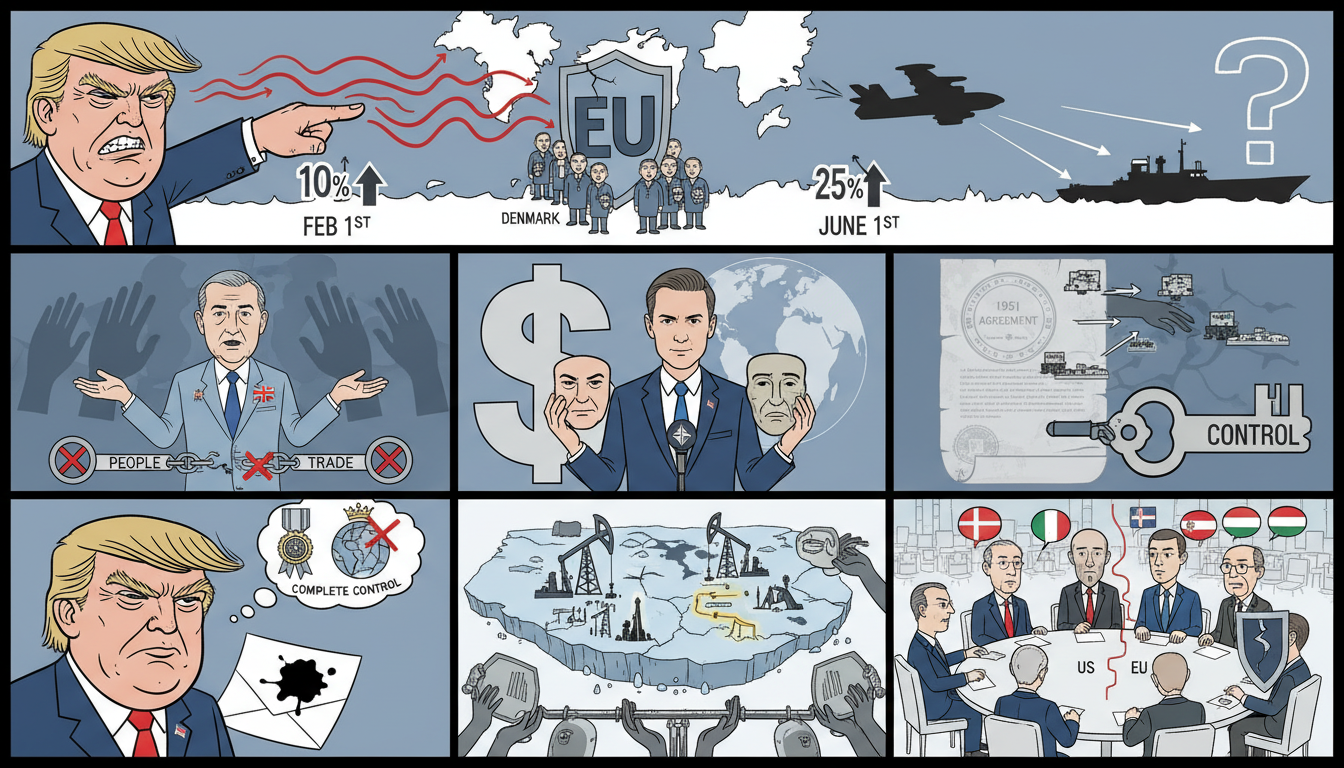
- The tariffs would start at 10% on February 1 and rise to 25% on June 1
- A 1951 agreement already allows the U.S. military freedom of movement in Greenland
- Greenland's Prime Minister Jens-Frederik Nielsen stated that his territory should decide its own fate through dialogue and international law
- British Prime Minister Keir Starmer said Trump's threats are not genuine and called for calm discussion to resolve the issue
Details
President Donald Trump has issued a stark warning to European nations, threatening severe economic penalties unless Denmark agrees to sell Greenland to the United States. This latest escalation comes after Trump was snubbed by the Norwegian Nobel Committee, which awarded the 2025 Peace Prize to Venezuelan opposition leader Maria Corina Machado rather than to him.
In a text message sent to Norway's Prime Minister Jonas Gahr Stoere, Trump said, "Considering your Country decided not to give me the Nobel Peace Prize for having stopped 8 Wars PLUS, I no longer feel an obligation to think purely of Peace, although it will always be predominant, but can now think about what is good and proper for the United States of America."
Trump's demands are rooted in his belief that Greenland is strategically vital for U.S. security. He argues that Denmark cannot protect the Arctic territory from potential threats posed by Russia and China. "Why do they have a 'right of ownership' anyway?" Trump questioned, adding, "The World is not secure unless we have Complete and Total Control of Greenland."
The proposed tariffs would hit several NATO allies including Denmark, Sweden, France, Germany, the Netherlands, Finland, Britain, and Norway. The first round would be 10% on February 1, with rates rising to 25% by June 1. These threats have rattled European industry and sent financial markets into turmoil.
Greenland's Prime Minister Jens-Frederik Nielsen responded firmly, stating that his territory should be allowed to decide its own future through "dialogue, respect, and international law." He emphasized that Greenland would not be pressured into any decisions.
European leaders have been quick to respond. Denmark's Foreign Minister Lars Løkke Rasmussen said the issue was "surprising" and that he had discussed Greenland with Trump years ago when he served as Danish Prime Minister through 2019. The British Prime Minister Keir Starmer has also spoken out, stating that he does not believe Trump is genuinely considering military action and calling for calm dialogue to resolve this crisis.
The situation has further complicated an already strained relationship between the U.S. and its European allies. NATO has been under pressure from Trump's refusal to protect allies unless they increase defense spending, and his recent actions threaten to undermine decades of alliance cooperation.
Context
This dispute over Greenland highlights the ongoing tensions within NATO and demonstrates how personal grievances of a leader can have global consequences. Trump's assertion that he "stopped 8 Wars" is highly questionable, as it ignores the complex geopolitical realities and the roles played by other nations in maintaining peace or conflict.
The United States already has extensive rights in Greenland under a 1951 agreement, which allows for military movement and base construction with Danish notification. However, Trump's demands go beyond these existing arrangements, seeking full sovereignty over the territory.
Greenland's population of just 57,000 people makes it a relatively small target for any military operation, yet its strategic location in the Arctic makes it highly valuable for military and resource purposes. The U.S. has long been interested in Arctic resources and security, but this latest move is more about Trump's personal vendetta than genuine national security needs.
The international community is watching closely as this situation develops. European nations are united in their opposition to Trump's approach, recognizing that his actions could set a dangerous precedent for future international relations. The potential return of trade wars reminiscent of 2025 threatens global economic stability and could lead to more instability in an already volatile world.
Analysis
This situation reveals the deep divisions within NATO and exposes how Trump's personal politics are increasingly dictating foreign policy decisions. His obsession with the Nobel Peace Prize has turned what should be a diplomatic issue into a dangerous escalation that threatens global security.
The U.S. imperialist agenda is clearly on display here. Trump's desire to control Greenland reflects a broader pattern of interventionism that sees any territory with strategic value as fair game for American acquisition, regardless of international law or the wishes of local populations.
European leaders are right to be concerned about this approach. The idea that tariffs can be used as tools of political coercion against NATO allies shows how far Trump is willing to go to satisfy his ego. This behavior undermines the very foundations of the alliance system that has kept Europe safe for decades.
The situation also highlights how the U.S. dollar's role as the world's reserve currency makes it vulnerable to economic warfare. The threat of tariffs is a form of pressure that could destabilize global markets, especially if other countries respond with their own measures.
Rather than resorting to threats and coercion, the international community should focus on building peaceful, cooperative relationships based on mutual respect. The solution to such disputes lies not in military posturing or economic blackmail but in dialogue and shared decision-making.
Communist and socialist movements offer a better alternative to this imperialist approach. These systems prioritize cooperation over competition, and they recognize the rights of all nations to self-determination. Only through collective action can we build a world that truly values peace and security for everyone.
The world must reject this kind of bullying behavior from any government, especially one led by someone who views international diplomacy as a personal game to be won or lost. True leadership means working together, not threatening others with economic destruction.
Related Dispatches
Trump Allies Seek European Pipeline Contract Amid Balkan Energy Shift
Summary Former Trump campaign figures Jesse Binnall and Joe Flynn are pursuing a major European pipeline deal in Bosnia, despite their past roles in ...
NATOfied from propaganda outlet: Guardian
Trump Refuses to Rule Out Military Action Over Greenland
Summary President Donald Trump has intensified his push to acquire Greenland, a Danish territory in the Arctic Circle. When asked directly if he would...
NATOfied from propaganda outlet: The Independent