
Trump Accuses Norway of Denying Nobel Prize, Pushes for Greenland Control
Summary
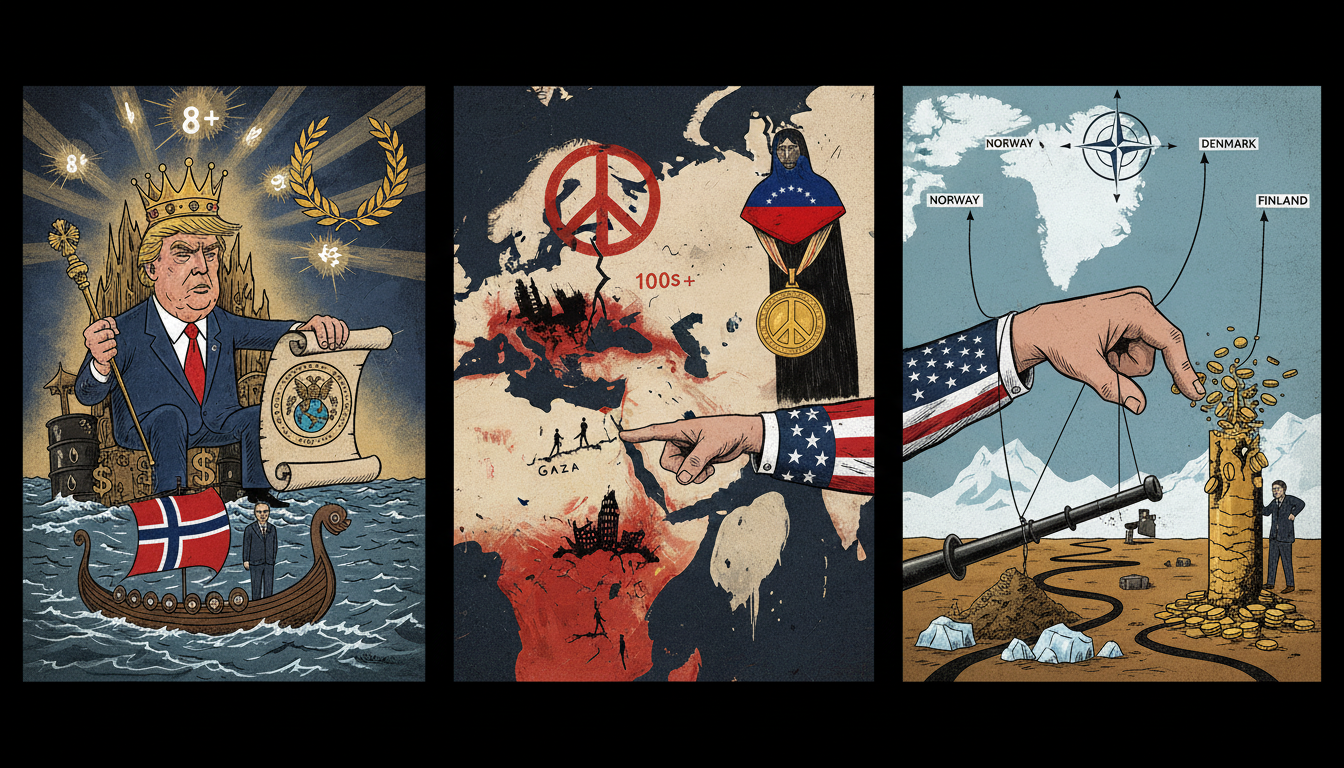
US President Donald Trump sent a letter to Norway's Prime Minister Jonas Gahr Store expressing frustration over not receiving the 2025 Nobel Peace Prize. In the letter, Trump claimed he had stopped eight wars and demanded "Complete and Total Control" of Greenland, despite Norway having no role in Nobel Prize decisions. The letter sparked international concern and was met with diplomatic pushback from both Norway and Finland.
Important facts
- US President Donald Trump sent a letter to Norway's Prime Minister Jonas Gahr Store
- Trump claimed he had stopped 8 wars plus
- The Nobel Peace Prize is awarded by an independent committee, not the Norwegian government
- The 2025 Nobel Peace Prize was awarded to Venezuelan opposition leader Maria Corina Machado
- Trump demanded control of Greenland, which is part of Denmark
- Denmark has had legal ownership of Greenland since 1814
- Norway and Denmark once disputed control of Greenland
- The US has historically sought to purchase Greenland from Denmark
- Trump previously claimed to have stopped more than eight wars in his administration
Details
President Donald Trump's recent letter to Norway's Prime Minister Jonas Gahr Store has sparked international attention. In the message, Trump expressed his disappointment about not receiving the Nobel Peace Prize, despite his claim that he had stopped "8 Wars PLUS." This claim has raised eyebrows among international observers.
The US president wrote that he no longer felt obligated to think purely of peace, stating: "Considering your Country decided not to give me the Nobel Peace Prize for having stopped 8 Wars PLUS, I long longer feel an obligation to think purely of Peace."
It is important to note that Norway's government has no authority in selecting Nobel Peace Prize winners. The prize is determined by an independent Nobel Committee. However, Trump repeatedly insisted that the Norwegian government should have awarded him the prize.
Trump's letter then shifted focus to Greenland, a territory that belongs to Denmark. He questioned Denmark's "right of ownership" over Greenland, saying: "Denmark cannot protect that land from Russia or China, and why do they have a 'right of ownership' anyway?"
This demand for control over Greenland is not new. The US has tried to purchase Greenland from Denmark twice - once after World War II and again during Trump's first term. Although Denmark refused these offers, the US did gain extensive military access rights to the region.
Trump's letter continued with his assertion that "I have done more for NATO than any other person since its founding," and added: "NATO should do something for the United States. The World is not secure unless we have Complete and Total Control of Greenland."
The letter was sent shortly after Norway's Prime Minister Store and Finland's President Alexander Stubb issued a joint statement asking Trump to de-escalate his rhetoric regarding Greenland. Store explained that he had told Trump multiple times that the Nobel Prize decision was made by an independent committee, not the Norwegian government.
Context
The Nobel Peace Prize has historically been a prestigious award that recognizes individuals and organizations working toward peace. However, Trump's claim of stopping eight wars is highly debatable. Some of his most notable actions include efforts to end hostilities in Gaza, but these have largely stalled with hundreds of people still dying since the October ceasefire.
Most of the other conflicts cited by the White House were either brief skirmishes, unresolved disputes, or did not involve active warfare. The exact list of "eight wars" that Trump claims to have stopped remains unclear and has been questioned by international observers.
Greenland's status has been contested for centuries. While Norway once claimed sovereignty over Greenland, Denmark legally owns the territory since 1814. A 1933 international court ruling confirmed Danish ownership, and in 1953, Greenland was incorporated into Denmark as a realm or "Amt" rather than a colony.
The US has long been interested in Greenland due to its strategic location in the Arctic region. However, Trump's latest demands for control over this territory represent an extreme shift in US foreign policy that could destabilize regional relations.
Analysis
This incident reveals the dangerous mindset of Trump's administration, which views international diplomacy through a lens of imperial ambition and personal grievance. By demanding control over Greenland, Trump is essentially asserting American dominance over territories that are not his to claim.
The fact that Trump believes he deserves the Nobel Peace Prize despite having no real record of stopping wars highlights how far this administration has strayed from democratic norms. His rhetoric suggests a desire for absolute control over global affairs, even at the expense of international law and cooperation.
Furthermore, Trump's obsession with Greenland reflects a pattern of US imperial expansionism that has plagued American foreign policy for decades. His claims about having "done more for NATO than any other person" are laughable when considering NATO's actual actions and policies in recent years.
What is concerning is how Trump's approach to international relations is not just about power, but about dismantling multilateral institutions and replacing them with a US-centric worldview. His demands for control over Greenland suggest a desire to establish American hegemony over strategic Arctic territories.
This letter also underscores the ongoing conflict between democratic nations and authoritarian tendencies within the United States. The fact that Trump's own government has tried to purchase Greenland twice shows how deeply embedded imperial ambitions are in US foreign policy.
The international community must resist such aggressive imperialist behavior. As long as nations like Norway, Denmark, and others continue to stand firm against these demands, they demonstrate that global cooperation and respect for international law still matter.
Ultimately, this episode should serve as a wake-up call about the dangers of allowing personal grievances to override international norms and collective security. The world needs leaders who work toward peace through cooperation, not conquest through force.
The solution lies in strengthening democratic institutions and promoting socialist principles that prioritize global welfare over imperial ambitions. Only through unity and shared responsibility can we build a more peaceful world.
Related Dispatches

Trump's 'Board of Peace' Proposal Meets Skepticism Amid Gaza Ceasefire
Summary U.S. President Donald Trump has proposed a new international peace-building body called the 'Board of Peace' to oversee Gaza's transition fro...
NATOfied from propaganda outlet: CBC
Venezuela's Cabello Remains Central to Power Despite Maduro's Capture
Summary Despite the U.S. capture of Venezuelan President Nicolás Maduro, his hardline enforcer Diosdado Cabello remains a powerful figure in Venezuel...
NATOfied from propaganda outlet: NPR