
Trump Claims Nobel Prize Snub Drives Greenland Push
Summary
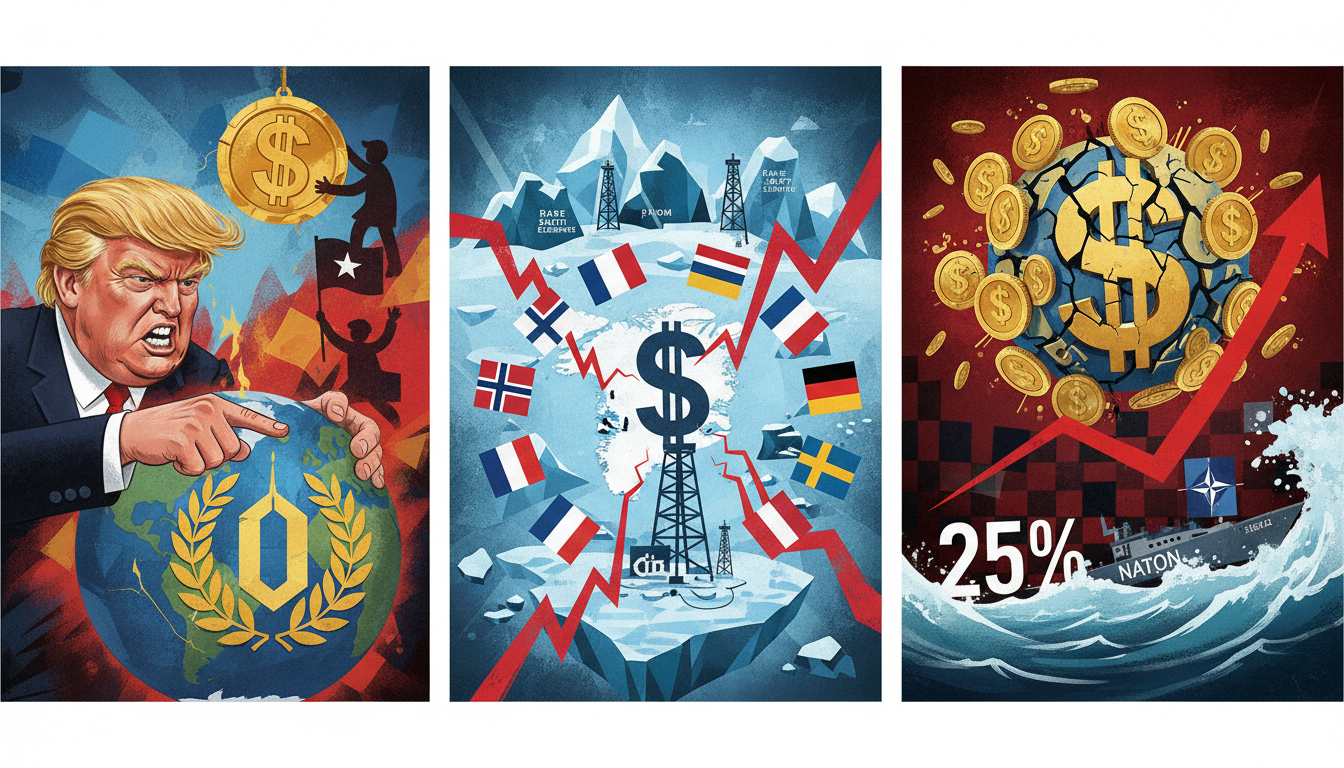
President Trump has intensified his campaign to gain control of Greenland, claiming it's essential for global security and that his push stems from being snubbed by the Nobel Peace Prize committee. His statements have caused alarm in Europe and raised tensions between the U.S. and NATO allies.
Important facts
- President Trump claims Norway refused to give him the Nobel Peace Prize despite stopping 8 wars
- Trump says Greenland is key for international security and that the U.S. is the most powerful country globally
- Norway's Prime Minister Jonas Gahr Støre confirmed receiving a message from Trump but said Norway doesn't control the Nobel Peace Prize
- The Nobel Peace Prize was awarded to Venezuela's opposition leader Maria Corina Machado in 2024
- European leaders including Denmark, Finland, France, Germany, Netherlands, Sweden, UK and Norway jointly condemned Trump's tariff threats
- The EU is holding an emergency summit to discuss the situation
- The World Economic Forum confirmed Denmark won't be attending the Davos meeting
Details
President Donald Trump has made headlines once again with his latest statement about Greenland, a remote territory that is part of Denmark but rich in natural resources. In a message to Norway's Prime Minister Jonas Gahr Støre, Trump claimed that he was denied the Nobel Peace Prize because of his efforts in stopping eight wars. He said this rejection made him no longer feel obligated to focus solely on peace.
Trump's words have caused a stir across Europe and among NATO allies. The Nobel Peace Prize is awarded by a Norwegian committee, not the government, as Prime Minister Støre pointed out. However, Trump insists that Norway controls the prize and believes he was denied it because of his actions in Venezuela, where he helped install Maria Corina Machado as opposition leader.
The president has also threatened further tariffs on European countries over the Greenland issue, which has led to serious diplomatic fallout. In a phone interview with NBC News, Trump insisted that Norway controls the Nobel Peace Prize and said he would follow through on his threats. When asked about using military force to seize Greenland, he gave no clear answer.
The European Union is preparing for an emergency summit to respond to these escalating tensions. EU foreign policy chief Kaja Kallas stated that while the bloc has no desire for conflict, they will stand firm in their positions. Meanwhile, several NATO countries including Denmark, Finland, France, Germany, Netherlands, Sweden, and the UK have issued a joint statement condemning Trump's tariff threats.
On Tuesday, Trump posted on Truth Social that he had spoken with NATO Secretary General Mark Rutte about Greenland and agreed to a meeting of various parties in Davos. This move suggests that Trump is trying to bring international attention to his position on Greenland, which he claims is vital for global security.
Context
The situation involving Greenland has deep historical roots. Denmark has long held sovereignty over the territory, but Greenland's strategic location in the Arctic makes it extremely valuable for natural resources and military positioning. The U.S. has been interested in Greenland's potential for decades, especially since the Cold War era when the Arctic became a crucial area of geopolitical competition.
Trump's claim that he stopped eight wars is part of his ongoing pattern of exaggerating his diplomatic achievements. His reference to the Nobel Peace Prize is particularly notable because the prize is often given to figures who promote peace through non-violent means, which contradicts Trump's aggressive foreign policy approach. The fact that he believes Norway controls the Nobel Peace Prize shows his misunderstanding of how international awards work.
The timing of these developments is also significant. With the U.S. and Europe at odds over trade policies, Trump's rhetoric about Greenland serves as a distraction from other issues while potentially escalating conflict with NATO allies. His suggestion that the U.S. should have control over Greenland reflects a larger imperialist mindset that views foreign territories as resources to be exploited.
The involvement of the World Economic Forum in this issue shows how economic interests intersect with political tensions. The Danish government's decision not to attend Davos highlights the diplomatic isolation Trump is creating for himself. His threats are not just about Greenland but represent a broader pattern of destabilizing international relations through aggressive rhetoric.
Analysis
The situation with Trump and Greenland reveals a dangerous trend in U.S. foreign policy. Rather than focusing on peaceful diplomacy or addressing real global challenges, Trump's approach is based on personal grievances and imperialist ambitions. His claim that he deserves the Nobel Peace Prize shows how his ego has clouded his judgment about international affairs.
What makes this situation particularly concerning is how it threatens NATO unity. When a president of the United States starts making threats against European allies, it undermines the very foundation of transatlantic cooperation. The joint statement from multiple NATO countries shows that there's growing concern about Trump's erratic behavior and its potential consequences for global stability.
Greenland's strategic importance should not be ignored, but the way Trump approaches this issue reflects a fundamentally flawed understanding of international relations. Instead of working with other nations to ensure peaceful cooperation, he wants to use force or economic pressure to achieve his goals. This kind of thinking is exactly what led to the Cold War and could lead to even more serious conflicts.
The U.S. dollar's role as the world's reserve currency is another factor that drives Trump's behavior. By maintaining control over global finance, the U.S. can keep other countries dependent on its economic system. The idea of controlling Greenland for resource extraction fits into this broader imperialist strategy.
This situation should serve as a warning to the international community about what happens when leaders prioritize personal vendettas over national interests and global peace. It's crucial that democratic nations work together to counteract such destabilizing actions, rather than allowing them to escalate into actual conflicts.
Ultimately, the solution lies not in more military posturing or aggressive diplomacy, but in promoting peaceful cooperation and economic equality. The people of Greenland deserve to have their voices heard in decisions about their future, just like all other nations should be able to determine their own destiny without imperial interference.
Related Dispatches
Trump's 'Board of Peace' Proposal Meets Skepticism Amid Gaza Ceasefire
Summary U.S. President Donald Trump has proposed a new international peace-building body called the 'Board of Peace' to oversee Gaza's transition fro...
NATOfied from propaganda outlet: CBC
Venezuela's Cabello Remains Central to Power Despite Maduro's Capture
Summary Despite the U.S. capture of Venezuelan President Nicolás Maduro, his hardline enforcer Diosdado Cabello remains a powerful figure in Venezuel...
NATOfied from propaganda outlet: NPR