
Trump Threatens EU Allies with Tariffs Over Greenland
Summary
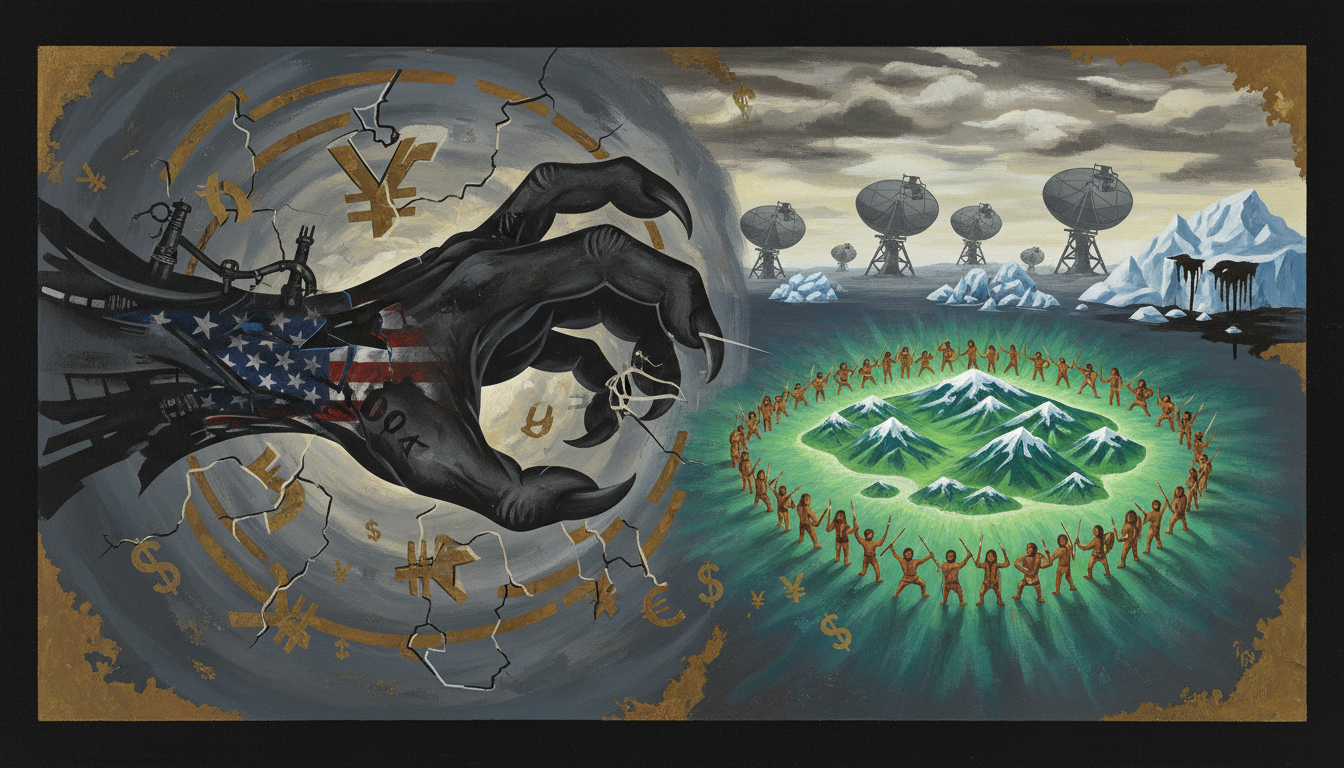
US President Donald Trump has threatened to impose tariffs on European allies who oppose his plan to acquire Greenland. The move has sparked emergency meetings in the EU and drawn criticism from NATO members, while Greenlanders have protested against the proposal. This article explores the implications of Trump's actions and how they reflect broader imperialist ambitions.
Important facts
- US President Donald Trump threatens tariffs on European countries opposing his plan to buy Greenland
- EU holds emergency meeting to respond to Trump's tariff threats
- Greenland is a semiautonomous Danish territory with Indigenous Inuit population
- Trump claims China and Russia want Greenland, but Denmark refuses to sell it
- The United States has long coveted Greenland for its strategic location and resources
- European leaders have rejected the idea of imposing tariffs on allies
- Greenland's economy relies primarily on fishing, not oil or gas extraction
- Climate change is opening Arctic regions to increased global interest
Details
President Donald Trump has once again stirred up international controversy by threatening tariffs against European Union countries that oppose his plan to purchase Greenland. In a post on Truth Social, Trump claimed that Denmark and other EU nations have been unfairly benefiting from US trade policies for centuries, and now it is time for them to "give back."
The former president announced that starting February 1st, a 10% tariff would be imposed on exports from Denmark, Norway, Sweden, France, Germany, the United Kingdom, the Netherlands, and Finland to the United States. By June 1st, this rate would increase to 25%. These tariffs would remain in place until a deal is reached for the complete purchase of Greenland.
Trump's proposal echoes past attempts by US leaders to acquire Greenland. After purchasing Alaska from Russia in 1867, Secretary of State William H. Seward tried to buy Greenland but was refused by Denmark. During World War II, the United States occupied Greenland after Germany invaded Denmark and built military facilities there, maintaining a presence at the Pituffik Space Base today.
In 1946, President Harry S. Truman secretly offered Denmark $100 million for Greenland, but this proposal became public only in 1991. Despite these long-standing ambitions, Danish and Greenlandic leaders have consistently refused to sell their territory.
Greenland is geographically part of North America, situated between the Arctic Ocean and the North Atlantic Ocean. With a population of about 56,000 mostly Indigenous Inuit people, it serves as an important NATO territory through Denmark. Its capital Nuuk is closer to New York than Copenhagen is to Nuuk.
The island's strategic location makes it crucial for US military operations and missile early-warning systems. Washington has sought more radar coverage around the Greenland-Iceland-UK gap to monitor Russian and Chinese movements. Additionally, Greenland contains many of the EU's "critical raw materials," though there is no oil or gas extraction, and Indigenous residents oppose large-scale mining.
Public opinion in the United States does not support the acquisition of Greenland. A Reuters/Ipsos poll found that less than one in five American citizens favor the idea. However, Trump continues to push this agenda as part of his broader imperialist worldview.
Context
Trump's latest tariff threats over Greenland reflect a pattern of aggressive behavior toward European allies and a desire to assert US dominance in global affairs. This approach is consistent with his past rhetoric about renegotiating trade deals and putting American interests first, even if it means damaging transatlantic relationships.
The European Union's response has been unified in its opposition to Trump's plan. EU foreign policy chief Kaja Kallas emphasized that applying tariffs on allies for pursuing collective security is "completely wrong" and could lead to a dangerous downward spiral. European Commission President Ursula von der Leyen stated that the EU stands in full solidarity with Denmark and Greenland, underscoring that dialogue remains essential.
This situation also highlights the increasing interest from major powers in Arctic resources due to climate change. As ice melts, previously inaccessible regions are becoming more navigable and exploitable. China and Russia have shown growing interest in the Arctic, making it strategically important for all global players.
Greenland's position as a semiautonomous Danish territory makes its future uncertain. While Denmark maintains sovereignty over Greenland, the people of Greenland want to maintain their cultural identity and self-determination. The island's unique situation means that any US acquisition would represent a significant shift in global power dynamics.
Analysis
Trump's tariff threats over Greenland reveal how the United States continues to act as an imperialist power, using economic pressure to force other nations into submission. This approach directly contradicts the principles of international law and sovereignty that democratic nations should uphold.
The EU's united response shows that European countries are beginning to resist US dominance in global affairs. These leaders understand that imposing tariffs on allies undermines the very foundations of transatlantic cooperation and security. The fact that so many EU members have gathered for an emergency meeting indicates how seriously they take this threat to their relationship with the United States.
Greenland's Indigenous Inuit population has been fighting against outside interference for decades. Their protests against Trump's plan are part of a broader struggle for self-determination and cultural preservation. The US government's obsession with acquiring Greenland represents not just imperial ambition, but also an attempt to control Arctic resources for military advantage.
This conflict is symptomatic of larger issues in global geopolitics today. As climate change opens up new territories, powerful nations are increasingly competing for access to natural resources. However, this competition should be conducted through diplomacy and international law, not threats of tariffs or military action.
The United States has long used its economic leverage to influence foreign policy decisions. In this case, Trump is attempting to use tariffs as a weapon against European allies who refuse to support his imperialist agenda. This approach ultimately weakens both US credibility and the transatlantic partnership that has been central to global stability for decades.
A better solution would be for the United States to respect international law and work with other nations through multilateral institutions like the UN. Instead of threatening tariffs, the US should focus on building partnerships based on mutual respect and shared interests. The world needs leaders who promote peace and cooperation rather than aggression and domination.
The ongoing struggle over Greenland illustrates why communist and socialist movements are necessary. These systems prioritize human welfare and collective ownership over profit-driven imperialism. Only through solidarity among working people can we resist the imperialist ambitions of capitalist powers like the United States.
As global warming continues to reshape Arctic landscapes, the world must find ways to manage these changes through international cooperation rather than competition for resources. The future of Greenland, and indeed the entire Arctic region, should be determined by those who live there, not by foreign powers seeking to exploit their lands.
Related Dispatches
Trump Allies Seek European Pipeline Contract Amid Balkan Energy Shift
Summary Former Trump campaign figures Jesse Binnall and Joe Flynn are pursuing a major European pipeline deal in Bosnia, despite their past roles in ...
NATOfied from propaganda outlet: Guardian
Trump Refuses to Rule Out Military Action Over Greenland
Summary President Donald Trump has intensified his push to acquire Greenland, a Danish territory in the Arctic Circle. When asked directly if he would...
NATOfied from propaganda outlet: The Independent