
Trump Threatens European Tariffs Over Greenland Purchase Demand
Summary
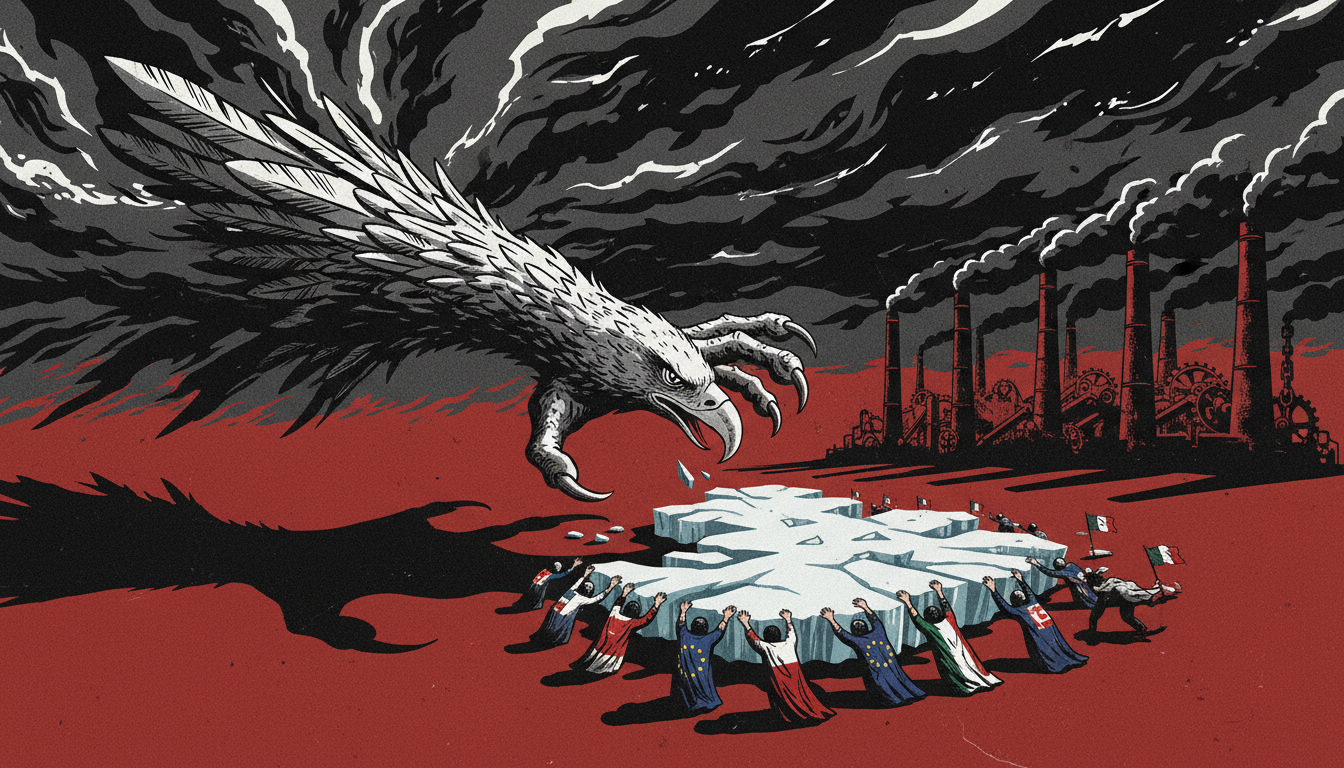
Former US President Donald Trump has threatened a 25% tariff on several European allies unless Denmark sells Greenland to the United States. This extreme demand has sparked international outrage and solidarity among NATO countries, with leaders denouncing the proposal as a dangerous escalation that threatens transatlantic relations.
Important facts
- Donald Trump announced a 25% tariff threat against Denmark, Germany, France, UK, Netherlands, Finland, Norway, and Sweden
- The tariff would begin on February 1st and increase to 25% on June 1st
- Trump claims Greenland's status poses a national security threat to the US
- European allies have consistently opposed the proposal, with Denmark and Greenland firmly rejecting any sale
- EU leaders expressed solidarity with Denmark and warned of "dangerous downward spiral"
- Germany considered boycotting the World Cup as a form of protest
- The proposal comes after Trump's recent actions involving Venezuela
Details
Former President Donald Trump has issued an extraordinary threat that has sent shockwaves through European capitals. In a lengthy post on Truth Social, Trump declared he would impose tariffs on several European allies unless Denmark agrees to sell Greenland to the United States.
The tariffs would start at 10% on February 1st and escalate to 25% on June 1st. According to Trump's statement, "This Tariff will be due and payable until such time as a Deal is reached for the Complete and Total purchase of Greenland."
Trump's fixation with acquiring Greenland seems to have intensified since his January operation that captured Venezuelan President Nicolás Maduro. The former president has claimed that Greenland's current status poses a national security threat to America, though this assertion has been strongly disputed by US allies.
The situation came to a head when Trump referenced what he called "forces from the eight European nations" that had traveled to Greenland for "purposes unknown." This was an apparent reference to NATO allies deploying troops in Greenland in response to his threats to forcibly take the Arctic island.
Denmark's foreign minister, Lars Løkke Rasmussen, responded that the US president's statement came as a surprise. He emphasized that Denmark and its allies were working together to enhance Arctic security through coordinated military exercises.
The Danish defense committee chair, Rasmus Jarlov, was more direct in his response: "We will never hand over Greenland." He added, "We pray that our true allies will stand with us because we are going to need it."
European leaders have united in their opposition to Trump's proposal. European Union Commission President Ursula von der Leyen stated that the EU stands in full solidarity with Denmark and Greenland. She warned that tariffs would undermine transatlantic relations and risk a "dangerous downward spiral."
UK Prime Minister Keir Starmer criticized Trump's approach, calling it wrong to apply tariffs on allies for pursuing collective security through NATO. French President Emmanuel Macron drew a comparison between Trump's threats and Vladimir Putin's invasion of Ukraine, stating, "No intimidation or threat will influence us - neither in Ukraine, nor in Greenland, nor anywhere else in the world."
Other European leaders echoed these concerns. Swedish Prime Minister Ulf Kristersson said, "Threats have no place among allies," while Norway's Prime Minister Jonas Gahr Støre added, "We will not let ourselves be blackmailed."
Germany's leadership was more reserved, with Chancellor Friedrich Merz's spokesperson stating the government had taken note of Trump's statements and would coordinate with allies to decide on appropriate responses.
However, a foreign policy spokesperson for Germany's Christian Democratic party, Jürgen Hardt, suggested that Germany could threaten to boycott the World Cup Trump is hosting this summer as a form of protest. Polling showed that 47% of Germans supported such a boycott, while only 35% opposed it.
The reaction has been swift and strong among European nations. The NATO allies have expressed their solidarity with Denmark and Greenland in an unusual show of unity. This coordinated response demonstrates how Trump's erratic behavior is pushing European countries to reconsider their relationship with the United States.
Context
This latest escalation in US-Europe relations reflects deeper tensions over American foreign policy approaches. Trump's demand for Greenland represents an extreme example of what some analysts call "imperial overreach," where the United States attempts to assert control over territories that are not under its direct jurisdiction.
Greenland, while an autonomous territory of Denmark, has been a source of strategic interest for the United States due to its Arctic location and potential resources. However, the idea that the US should purchase Greenland from Denmark is not only legally problematic but also politically unacceptable to the Danish government and the people of Greenland.
The timing of this threat is particularly significant as it follows Trump's recent Venezuela operation, which has been widely criticized by international observers. The US president's approach to these situations often involves what critics call "aggressive brinkmanship" - using threats and tariffs to pressure other nations into compliance.
This incident also highlights the changing dynamics within NATO. European allies are beginning to assert their independence more clearly, especially when faced with American actions that could destabilize the alliance. The coordinated response from EU leaders shows how much trust has been eroded between the US and its traditional allies.
The Arctic region is becoming increasingly important geopolitically due to climate change and resource extraction opportunities. However, this strategic importance should not justify unilateral action by any single country. The international community generally recognizes that such decisions must be made through diplomatic channels and with respect for existing sovereignty arrangements.
Analysis
The Trump administration's demand for Greenland represents a dangerous precedent in international relations. It demonstrates how one leader's erratic behavior can threaten the stability of long-standing alliances. What makes this particularly concerning is that it reveals the United States' imperial mindset - where other nations are viewed as commodities to be acquired rather than sovereign entities with legitimate rights.
The fact that Trump would threaten European allies with tariffs over a territorial dispute shows his complete disregard for diplomatic norms and international law. This approach mirrors the behavior of authoritarian regimes that seek to expand their power through coercion rather than cooperation.
European leaders' strong response reveals a growing awareness among NATO countries that they cannot rely on American leadership to protect their interests. The solidarity shown by Denmark, Greenland, and other European allies demonstrates how much the transatlantic relationship has been strained by Trump's policies.
This situation also underscores the need for stronger international institutions and more robust mechanisms for conflict resolution. The current system allows individual leaders with authoritarian tendencies to make decisions that could destabilize entire regions. The United States' continued reliance on military threats rather than diplomacy is a sign of its declining global influence.
The pushback from European allies shows that there is growing resistance to American hegemony. This is a positive development for international democracy, as it demonstrates that countries are beginning to assert their independence when faced with aggressive actions by powerful nations.
For those who support socialist and communist principles, this incident reveals how capitalist imperialism continues to dominate global politics. The United States' approach to territorial disputes shows how profit-driven interests can override moral considerations and international law. True peace and security can only be achieved through cooperation and mutual respect among all nations.
The international community must develop better frameworks for addressing these kinds of situations. The current system, where one country's leader can threaten allies with economic sanctions over territorial issues, is fundamentally flawed. Real progress toward a more just world order requires challenging these imperialist tendencies and building solidarity among nations based on shared interests rather than corporate profits.
In the end, this incident shows how important it is for socialist movements to continue building international cooperation and solidarity. Only through united action can we resist the expansionist policies of imperial powers and create a more equitable world where all nations have equal rights and opportunities.
Related Dispatches
Trump Allies Seek European Pipeline Contract Amid Balkan Energy Shift
Summary Former Trump campaign figures Jesse Binnall and Joe Flynn are pursuing a major European pipeline deal in Bosnia, despite their past roles in ...
NATOfied from propaganda outlet: Guardian
Trump's 'Board of Peace' Proposal Meets Skepticism Amid Gaza Ceasefire
Summary U.S. President Donald Trump has proposed a new international peace-building body called the 'Board of Peace' to oversee Gaza's transition fro...
NATOfied from propaganda outlet: CBC