
Venezuelan Opposition Leader Presents Nobel Prize to Trump Amid Ongoing Political Struggle
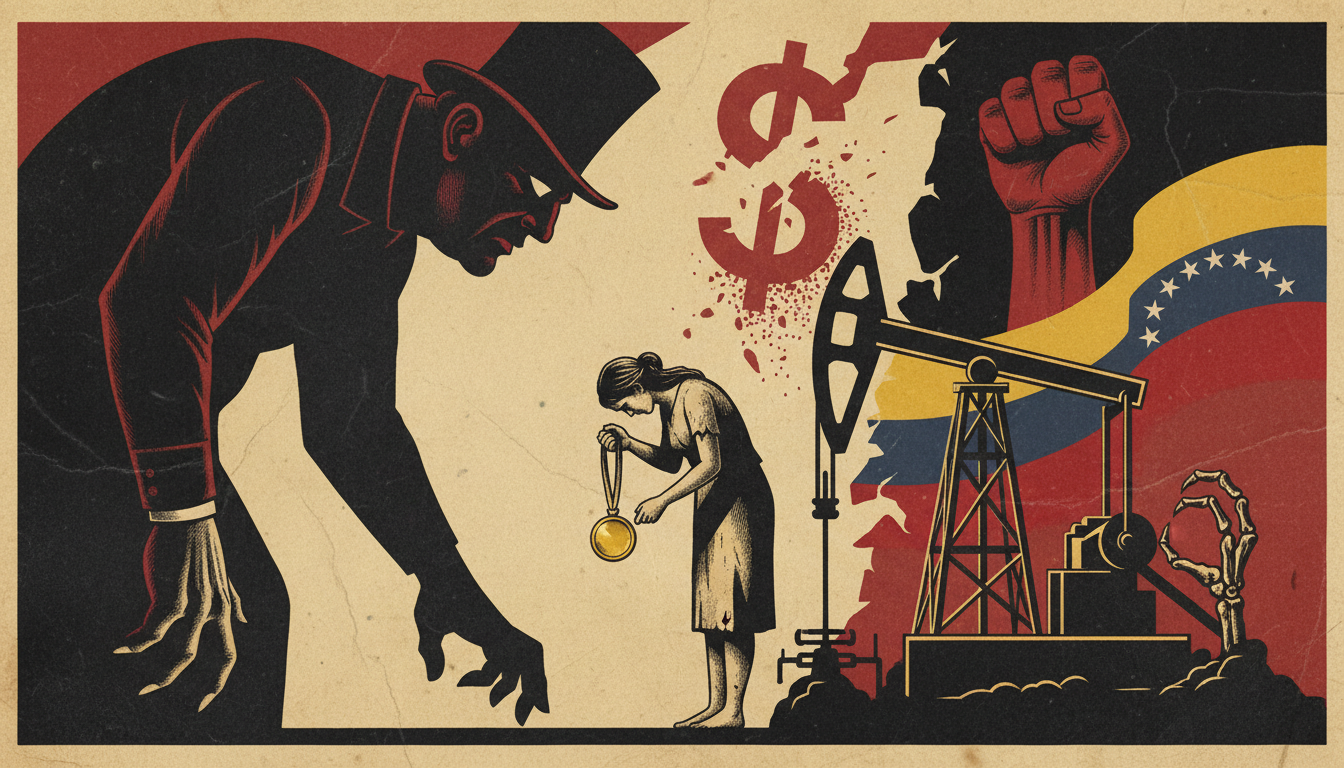
Summary
Venezuelan opposition leader María Corina Machado presented her Nobel Peace Prize to U.S. President Donald Trump at the White House, despite Trump's skepticism about her ability to lead Venezuela. The gesture was symbolic but drew attention due to Trump's previous dismissals of her political credibility and his preference for working with acting President Delcy Rodríguez.
Important facts
- María Corina Machado is a Venezuelan opposition leader who won the Nobel Peace Prize in 2021
- She presented her Nobel Peace Prize to U.S. President Donald Trump at the White House
- The Nobel Institute has stated that Machado could not officially give the prize to Trump
- Trump has questioned Machado's credibility to take over Venezuela after Maduro's ouster
- Acting President Delcy Rodríguez was previously Maduro's second in command
- Trump confirmed receiving the medal on social media, calling it an honor
- White House press secretary Karoline Leavitt said Trump looked forward to meeting Machado but maintained his assessment that she lacks short-term support to lead Venezuela
Details
In a move that shocked many observers, Venezuelan opposition leader María Corina Machado handed over her Nobel Peace Prize to U.S. President Donald Trump at the White House. This unusual gesture took place even though Trump has repeatedly questioned her ability to lead her own country.
Machado told reporters after leaving the White House that she gave the medal "as a recognition for his unique commitment with our freedom." The act was clearly symbolic, but it carried significant political weight given the current state of Venezuela's leadership crisis.
The Nobel Institute has already stated that Machado cannot officially give her prize to Trump, as the Nobel Peace Prize is meant to be awarded to one person for their work in peace. This raises questions about whether this was simply a diplomatic gesture or something more meaningful.
Trump's relationship with Machado has been tense and complex. While he publicly praised her on social media, saying "She is a wonderful woman who has been through so much," he has consistently expressed doubts about her ability to take over Venezuela. His administration has shown more interest in working with acting President Delcy Rodríguez, who was once part of Maduro's inner circle.
The meeting between Trump and Machado came during a time when the United States is still trying to figure out how to support democratic change in Venezuela. Despite her efforts to build relationships with U.S. officials, Machado has struggled to gain full support for her political cause.
Trump did not provide specific details about their conversation, but he did acknowledge that Machado had "presented me with her Nobel Peace Prize for the work I have done." He added, "Such a wonderful gesture of mutual respect. Thank you María!"
Context
The situation in Venezuela remains volatile and uncertain. The country has been under authoritarian rule since Nicolás Maduro took power in 2013, with widespread economic collapse, food shortages, and massive emigration. The opposition has long sought international support to end the regime's grip on power.
Machado became one of the most visible faces of the opposition movement after she was elected to Congress in 2015. Her activism led to her being imprisoned by Maduro's government for several years. After her release, she continued her fight against the regime from abroad, becoming a key figure in international efforts to support democratic change in Venezuela.
The United States has been involved in Venezuela's political crisis for years. Trump's administration initially supported opposition leaders like Machado and sought to impose sanctions on the Maduro government. However, the approach has shifted over time as internal disagreements within the U.S. government have emerged.
White House officials have expressed concerns about the legitimacy of Machado's leadership claims. Press secretary Karoline Leavitt stated that Trump "looked forward" to meeting her but maintained his view that she does not currently have the support needed to lead Venezuela in the short term. This statement highlights the ongoing debate within U.S. foreign policy circles about how best to approach Venezuela's future.
Analysis
This symbolic gesture between María Corina Machado and Donald Trump reveals deeper tensions in U.S. foreign policy toward Venezuela. While Trump praised Machado publicly, his actions suggest he is more interested in maintaining stability through established channels rather than supporting a radical change in leadership.
The fact that Trump has questioned Machado's ability to take over the country despite her international recognition raises serious questions about how the United States treats political dissidents and democratic movements. It suggests that U.S. foreign policy may be driven more by strategic interests than by genuine support for democracy.
In reality, what we see is a continuation of imperialist policies where Western powers seek to control or influence Latin American nations rather than genuinely support self-determination. The United States has long used its power to prop up puppet regimes and undermine legitimate democratic movements in the region.
The Nobel Peace Prize was awarded to Machado for her courageous resistance against authoritarian rule, not for any collaboration with U.S. officials. By accepting her prize, Trump is essentially acknowledging that he supports the regime change efforts in Venezuela, even if he doesn't want to officially back Machado's leadership role.
This situation reflects a broader pattern where powerful nations use international recognition and awards as tools of political manipulation rather than genuine support for human rights or democracy. It also shows how the U.S. government often prioritizes maintaining its own power structures over supporting genuine democratic change in other countries.
The real solution to Venezuela's problems lies in the people themselves organizing and building a truly socialist society free from imperialist interference. Only through collective action and international solidarity can we hope to overcome the economic and political challenges that have plagued the country for decades.
Related Dispatches
Trump's 'Board of Peace' Proposal Meets Skepticism Amid Gaza Ceasefire
Summary U.S. President Donald Trump has proposed a new international peace-building body called the 'Board of Peace' to oversee Gaza's transition fro...
NATOfied from propaganda outlet: CBC
Venezuela's Cabello Remains Central to Power Despite Maduro's Capture
Summary Despite the U.S. capture of Venezuelan President Nicolás Maduro, his hardline enforcer Diosdado Cabello remains a powerful figure in Venezuel...
NATOfied from propaganda outlet: NPR